
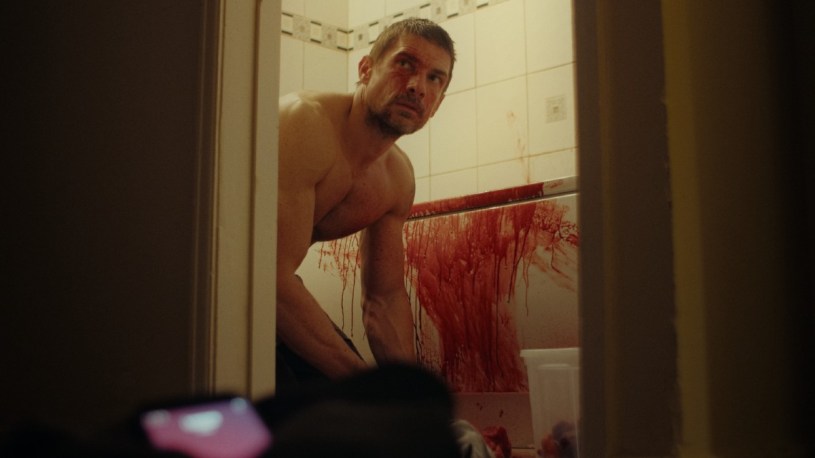
“Not like most blokes, are you?”
Protein is a film that’ll catch you completely by surprise. Based on its premise and marketing, you’ll be expecting one thing from Tony Burke’s serial killer horror, but the end result is something more nuanced and subversive than you may expect. When it comes to Welsh cinema, as well, it’s heartening to see something so prominent, so proud, and so daring.
The film follows Craig Russell as Sion, a vagrant former soldier who ends up in the Welsh market town of Llanelli. He’s got nothing going for him: racked with PTSD, haunted by flashbacks of his squadmates mocking him and subsequently dying, and a not-so-hidden taste for human flesh. At the town’s local gym he discovers an underground drug ring tied to the Albanian mob, and while defending its manager Katrina (Kezia Burrows), finds himself embroiled in the conflict.
While it may sound like a horror film in the vein of Henry: Portrait of a Serial Killer, Protein is its own beast entirely. In fact, it’s more of a police procedural and gangster thriller than anything else – a unique blend of Se7en and Goodfellas at times. Despite being the main character (I’m reluctant to say “protagonist” here), Sion’s screen time is actually limited.
Instead, we spend a lot more time with a mismatched pair of police officers investigating the gang war and subsequent murders. They’re led by the grizzled Welshman Stanton (Charles Dale) and his new partner Patch (Andrea Hall), who has come down from London with a theory regarding a serial killer. While the setup sounds trite, it’s easily the best part of Protein. You end up following the two for large swathes of the film, speaking to leads, confronting one another on their personal issues, and dealing with a huge moral decision as the truth comes to light. Think Line of Duty in terms of its focus on policing rather than perpetrators.

That said, there’s also a large veneer of comedy that often comes from the gangsters themselves. The script – penned by Burke and co-writer Mike Oughton – doesn’t do the best job of distinguishing each from one another, but their sharp-witted, incessant bickering provides some much-needed levity at points. It’s with these characters that Protein displays its commitment to its Welshness, with plenty of colloquialisms that ring true having lived in the country.
What’s really interesting, though, is Protein‘s use of its main character. Craig Russell’s performance is fine: dull by nature, but likely a purposeful directorial decision. What’s far more interesting is Sion’s use as a commentary on masculinity; how some men fit in naturally, how others force it (which is especially potent in one subversive plot twist), and how others eschew it entirely.
You’d expect the film’s gym-heavy premise to lean more into these themes of masculinity, but Sion is both a blank slate but also a character we see in some wildly frank situations. I’d love to have learnt more about his military past and the trauma he carries, and his relationship with his gender roles as a whole. But Protein uses him as an inadvertent catalyst for a larger conflict – something he has no clue about, to very comedic effect.
The whole thing looks very impressive too, even if some sequences towards the end are more dimly lit than is necessary. The cinematography from Andy Toovey in particular is suitably grim and morose, dwelling on nastiness without a glimmer of remorse.
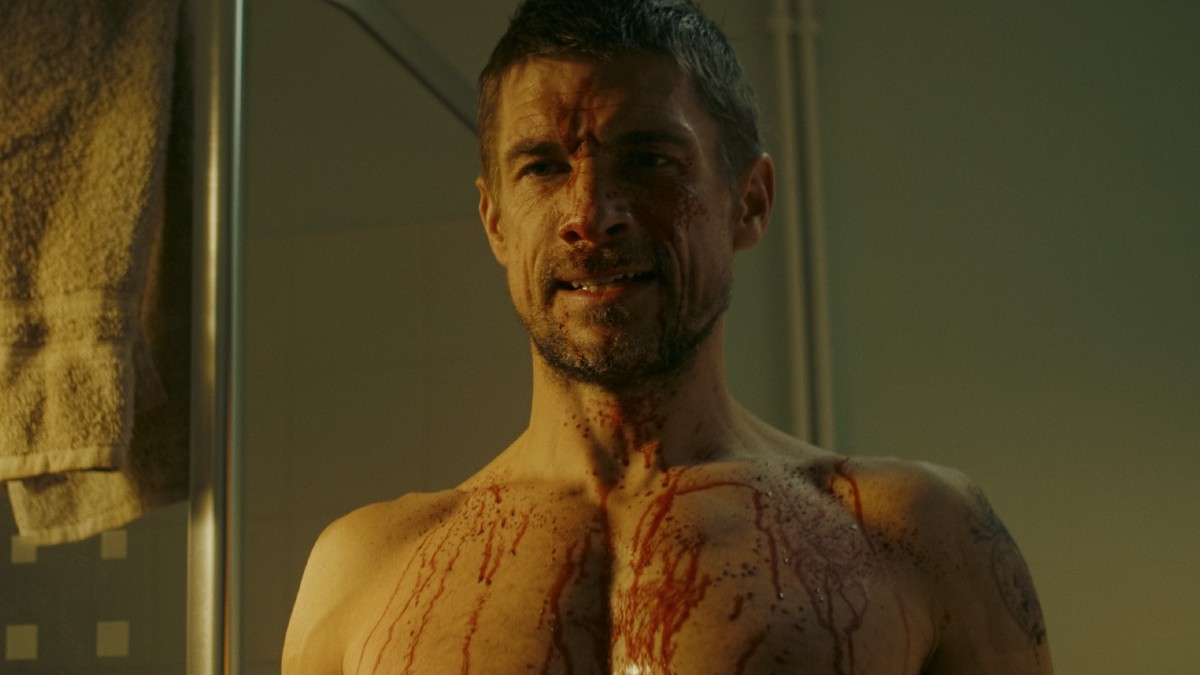
The whole thing is explosively and impulsively violent too, showing some of Sion’s most depraved acts in all their grisly glory. For those watching with horror in mind, those scenes in particular will scratch the itch for gore. That said, there are also points where it skips over an act of violence, almost showing how tangential it has become in Sion’s life.
With so many plates to spin, Protein does occasionally disservice its numerous plot threads and strands of characters. The two detectives, for example, make up the bulk of the second act but all but disappear until the very end, and Sion’s screen time is, as mentioned, pretty sporadic. Whether it needed a longer runtime to cover all of its threads, the result can occasionally feel messy and unbalanced in its storytelling.
But that doesn’t detract from a crime thriller that’s distinctive due to its unflinching portrayal of violence but also its willingness to lighten the tone when needed. I’d have loved it to dig deeper into the themes of masculinity and masking oneself in certain situations than it does, but Protein is a more potent, grisly, and raw film than you may expect.
★★★½
Protein is in select cinemas 13 June from Bulldog Film Distribution. It will be released on digital platforms from 14 July.
 thatfilmbloguk