
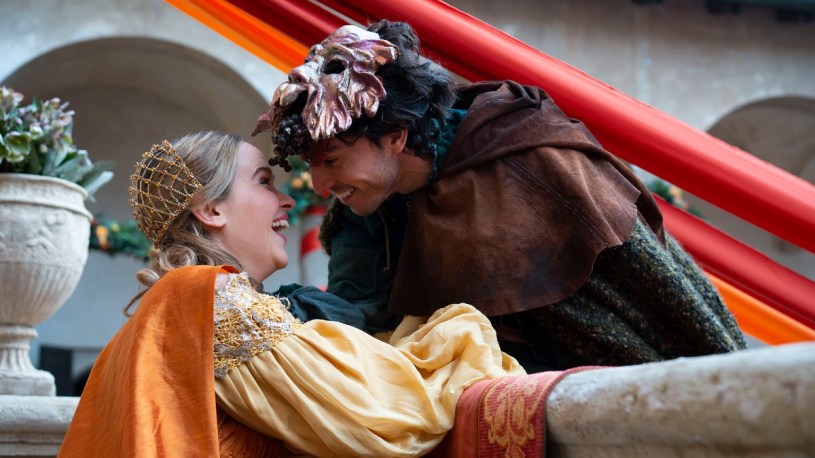
Making a Shakespeare adaptation in the 21st century is no easy feat. Not because of the dated subject matter, no. Instead, the problem is finding a unique spin: a way to tell these centuries-old stories in ways that resonate with modern audiences and actually justify their own existence. While its inverted title might point towards a similarly subversive approach, Juliet & Romeo is unfortunately as dull as they come.
The film stars Clara Rugaard and Jamie Ward as the star-crossed lovers, but it’s really the supporting cast that gives Juliet & Romeo its currency. Jason Isaacs is stoic but underused as Lord Montague, Rebel Wilson looks bored as Lady Capulet, and the beloved Derek Jacobi is actually pretty great as the diligent but equally petrified friar. The two leads aren’t just overshadowed by that star power, but they also don’t have the chemistry nor chops to carry the drama.

I use the term “drama” rather loosely, because there’s unfortunately not a huge amount of dramatic gumption on display in Juliet & Romeo. While the title would suggest a feminist retelling of the story, there’s nothing of the sort here. In fact, up until its very last shot it’s a fairly rote, stolid retelling of the story without any kind of innovative spin.
For that reason, it’s hard to see why anyone would choose this over unique adaptations such as Baz Luhrmann’s modernisation, or God forbid, Gnomeo & Juliet. Call it what you want, but at least it was trying something new. Either way, the overriding feeling you’ll have is one of wanting to watch a more competent adaptation in its stead.
That’s the overriding issue with Juliet & Romeo: a complete lack of desire to try anything different. The closest it has to a USP is a sprinkling of pop-inflected songs to turn it into a musical, but those are all dry, forgettable, and fail to serve the narrative. It’s also bizarrely dim throughout, with so much of the drama happening in moonlight or dingy drawing rooms that you’re squinting more than you’re bobbing your head to the music.
One thing Juliet & Romeo does a good job of is updating Shakespeare’s dialogue for a modern audience. It’s nicely written by Timothy Scott Bogart, who also directs, and for those experiencing the story for the first time, it’s digestible enough for a first go around before diving into the play properly. However, it’s a bit too safe and generic to spawn a new generation of Shakespeare fans, so don’t be surprised if this comes and goes with a whimper.
What’s most frustrating of all, though, taking all of its unoriginality out of the equation, is Juliet & Romeo‘s ending. It boldly eschews the famously grim conclusion of the original for something altogether more upbeat, and even teases a sequel at the very end.

That’s what irks me most – a sequel that tells an Elseworlds-style story where the lovers survive and carve out a life for themselves is exactly what this film should be. We don’t need a two-hour slog retelling a 400-year-old story before diving into something narratively propulsive – just go ahead and do it!
That’s what would’ve made Juliet & Romeo inventive, not an inverted title and a few cheesy pop numbers. It’s a shame that Bogart didn’t go down this route, because the likelihood of a sequel ever seeing the light of day is pretty slim.
It leaves Juliet & Romeo as a walking, talking (and singing) missed opportunity. For the first 115 minutes, there’s simply nothing unique or entertaining enough to justify its existence. By the time it does something with even a modicum of promise, the film is too far gone. If you want a flat retelling of the story, it’ll do that job – but the promise of a multiverse-style sequel should’ve been the core here, not a sequel tease.
★½
Juliet & Romeo will be in UK cinemas for one night only on 11th June.
 thatfilmbloguk