

It’s staggering to think that Spike Lee made Malcolm X quite so early on into his career. Sure, Lee already had some hits under his belt—She’s Gotta Have It, Do the Right Thing, and Jungle Fever to name but a few—but this somehow feels like the seminal work of a director who, at that point, had been in the game for six years. While less flashy on a filmmaking level than some of his other work, Malcolm X is undoubtedly one of Spike Lee’s very best films – and one of the best biopics ever made.
The film is a front-to-back exploration of the life of Denzel Washington’s Malcolm X (formerly Little), from his childhood spent in foster care to his ascent to one of 1960s America’s most prominent and controversial civil rights activists. Unlike vignette-based biopics like Danny Boyle’s recent Steve Jobs, this is as thorough as it gets, faithfully conveying the story as told in X’s 1965 autobiography.
As such, Malcolm X works both as entertaining historical epic and insight into Malcolm X’s politics and career as an activist. Of course, it works better viewed with at least a base level of contextual knowledge, but it’s also the kind of faithful, reverent film that wouldn’t be out of place in a school history lesson.
That inherent quality is down to two main factors, the first being Lee’s precise, thoughtful direction. It’s far less visually flashy and arresting as some of his other films, notably She’s Gotta Have It and even later pictures like Da 5 Bloods, but that’s entirely the point. Lee lets the story and characters breathe, knowing when to fill a scene with punchy, political dialogue, and when to sit back and let the performances and production design do the heavy lifting. While it’s not as instantly recognisable as your classic Spike Lee Joint, it’s clearly a film borne out of total admiration for Malcolm X and a desire to tell the definitive, accurate version of his story.
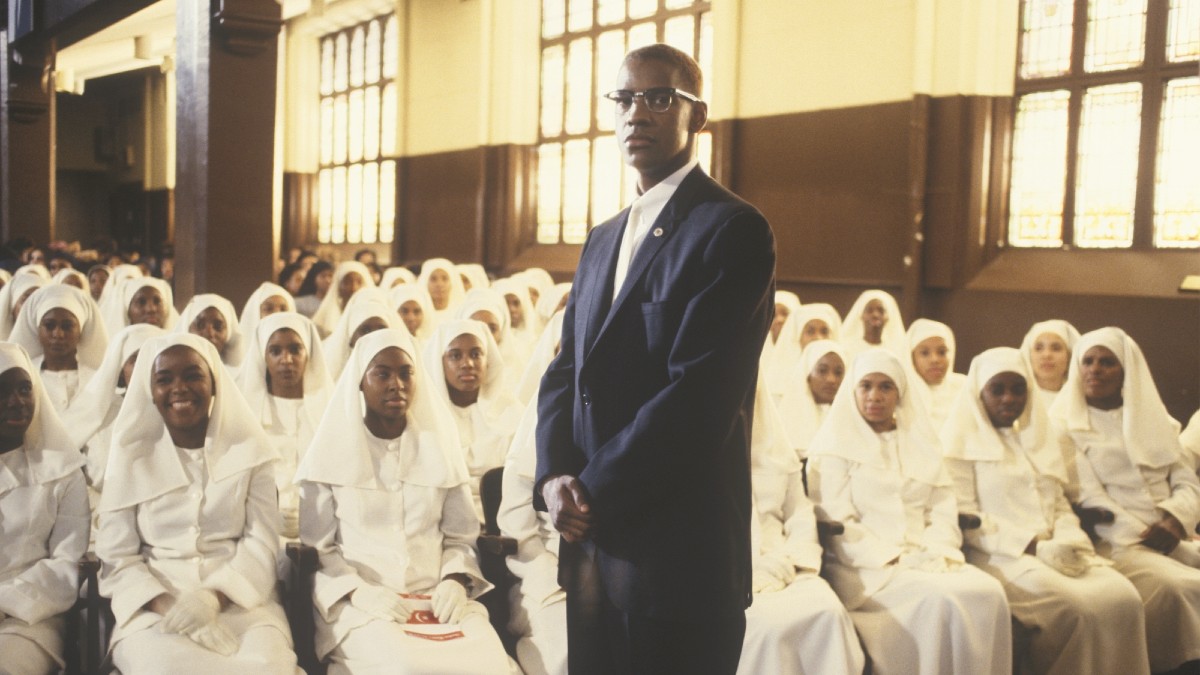
The film is also hugely indebted to a spellbinding lead performance from Denzel Washington. At this point in time he was already an Oscar winner for Glory, but Malcolm X feels like the film that propelled him to a different level of stardom; one that set him up as the bona fide A-lister he still is today. We’ve seen plenty of interpretations of Malcolm X on-screen—Kingsley Ben-Adir in One Night in Miami notably standing out—but Washington is on a wholly different level here.
Especially when compared to stock footage shown in montage at the end, it’s staggering to see just how much Washington imbues of X into his performance, from his soft, slightly beaverish speaking to his rollicking passion and ability to enchant a crowd. The performance really covers the whole gamut of emotions, from seething, blank anger as Malcolm is sent to prison, to his mental instability in solitary confinement, to his regal position as an activist. Being able to capture so many stages of one man’s life is no easy job – especially for someone as incomparable as Malcolm X.

Yet sometimes it feels like Malcolm X is working against itself in how it chooses to set out its narrative. Sitting at the best part of three-and-a-half hours, there were numerous moments where I felt areas or sequences could’ve been tightened or reworked to give breathing room to some of the more crucial developments. The film spends nearly all of its first hour purely showing us Malcolm’s life before he got into activism, which is interesting but not quite as punchy as you’d like. It also means that some of the significant passages in time, such as his six years spent in prison or the 12 years during which he spent as an activist, get less intrinsic focus by comparison.
The film either could’ve used less of a first act-heavy approach, spending more time on his political feuds and assassination, or clearer signposting as to how much time has passed. Speaking of the assassination, it’s easily the film’s most paranoia-inducing segment that shines a light not just on a different facet of Washington’s performance, but also a stellar turn from a young Giancarlo Esposito – as such, it would’ve been nice to have a bit more time to experience this event.
Most of the time, though, the film knows exactly how to lay out its thesis and do so in a hugely compelling manner. The dialogue is punchy and kinetic, with the camera swinging back and forth between characters as they speak in high-intensity political debates that often feel like chess matches. Ava DuVernay’s career-best Origin instantly sprang to mind when watching this; both have a way of baking important racial theory into their narrative in a way that never feels inorganic or overly documentarian, but totally diegetic to the experience as a whole.
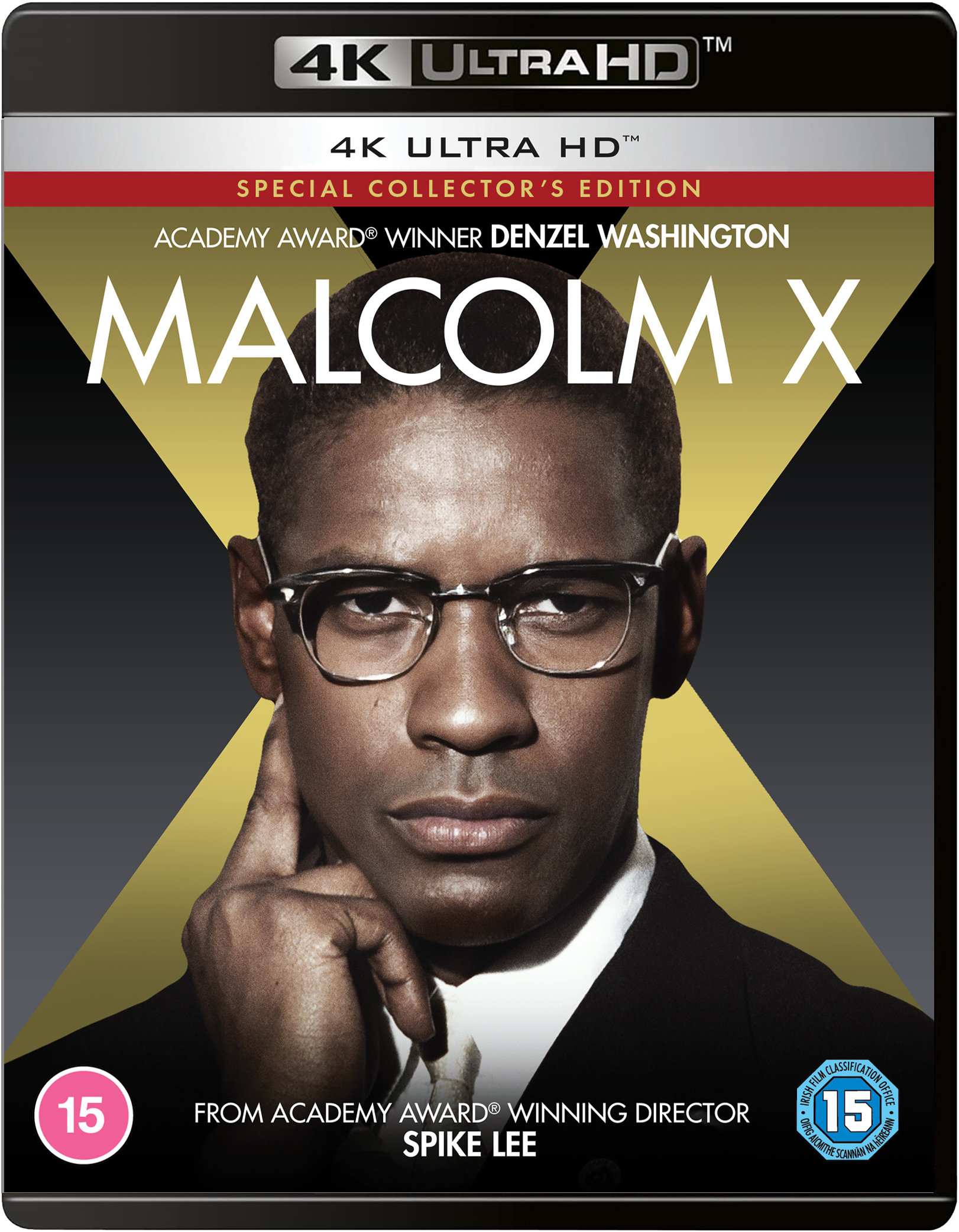
This new 4K restoration of Malcolm X is fortunately one that does the film huge justice. The image quality is crystal-clear, often leaving me staggered by how polished scenes looked, especially in colourful sequences. It’s simply the definitive way to watch the film now, even if I felt the audio could’ve used equal levels of care, with dialogue often sounding rather muffled.
Even though Spike Lee has gone on to make myriad hits in the decades since, Malcolm X remains his most important film – and one that has aged beautifully. It’s just as thematically resonant and directorially punchy as it’s ever been, striking the perfect balance between straight-laced retelling and auteur’s own spin on one of America’s most significant historical figures. You’d be hard-pressed to name a better-directed Spike Lee film, a better Denzel Washington performance, or a better historical biopic than Malcolm X.
★★★★
Malcolm X releases on 4K UHD and Blu-ray on July 29, 2024 from Icon Film Distribution.
 thatfilmbloguk